The Rise of the Full-Stack Data Scientist in the Age of Agentic Coding
The data science landscape is shifting. Traditional, siloed data teams are giving way to Full-Stack Data Scientists, an evolution fueled by agentic coding and the need for integrated data product development. This change is happening thanks to advances in data.
The Limitations of Traditional Data Teams
Building data products used to involve multiple specialists. (And I mean *multiple*.)
- Data Engineers: They handled data pipelines and infrastructure.
- Data Scientists: They focused on model building and analysis.
- Software Engineers: They deployed models into production.
- ML Engineers: They optimized models for performance and scalability.
- MLOps Teams: They managed the machine learning lifecycle.
- Product Managers: They defined product requirements and strategy.
This specialization allowed organizations to tackle complex problems, but it also created bottlenecks. So, was it worth it?
- Handoffs: Handoffs increased communication overhead and the potential for misinterpretation.
- Dependencies: Delays in one area could impact the entire pipeline.
- Slower Feedback Cycles: Iteration became cumbersome and time-consuming.
Agentic Coding: The Catalyst for Change
Agentic coding, powered by AI, is automating tasks traditionally performed by specialized roles, empowering data scientists to take on end-to-end ownership of data products. This shift is particularly relevant now, as companies strive to accelerate their AI initiatives and realize tangible returns on investment.
Defining the Full-Stack Data Scientist
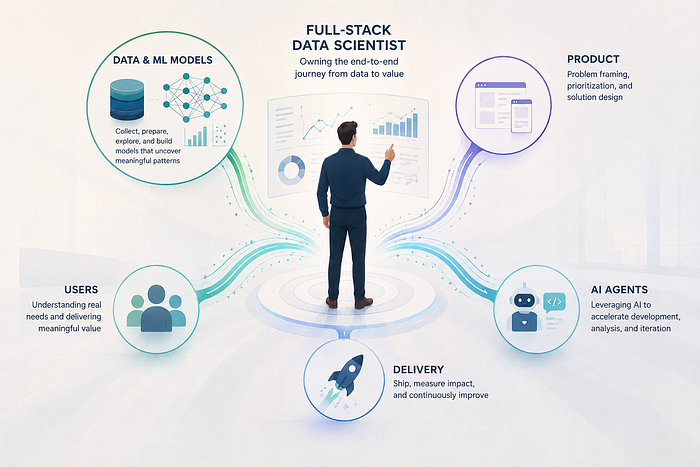
A Full-Stack Data Scientist combines:
- Data and Domain Expertise: A deep understanding of the data and the business context.
- Product Thinking: The ability to translate business needs into data-driven solutions.
- Accountability for Outcomes: Ownership of the entire data product lifecycle, from development to impact.
- Rapid Prototyping Skills: Quickly building and testing ideas using modern tools and techniques.
- Proficiency with Coding Agents: Leveraging AI-powered tools to accelerate development and automate repetitive tasks.
Why Data Scientists are Well-Suited for the Full-Stack Role
Data scientists are positioned to thrive in this environment because they operate at the intersection of:
- Technology: Expertise in data analysis, machine learning, and programming.
- Business: Understanding of business goals and how data can drive value.
- Uncertainty: Comfort with ambiguity and the ability to learn and iterate quickly.
How the Full-Stack Approach Works in Practice
The Full-Stack Data Scientist focuses on:
- Building Early Product Interfaces: Creating prototypes to demonstrate value and gather feedback.
- Focusing on Measurable Value: Prioritizing projects that deliver tangible business outcomes.
- Using Stakeholder Feedback to Refine Requirements: Continuously iterating based on user input and performance data.
The Agentic Era: Context and Judgment as Key Differentiators
AI handles much of the execution in the age of agentic coding, making context and judgment the most valuable assets for teams that can quickly align context, data, validation, and iteration. Industry analysis suggests that these "soft skills" will become even more critical as AI tools become more sophisticated.
A Mindset and a Management Philosophy
The rise of the Full-Stack Data Scientist requires a shift in mindset and management philosophy. It's not just about the tech; it's about how we *think* about the work.
Organizations need to:
- Empower Smaller, Capable Teams: Give teams the autonomy to own outcomes.
- Embrace AI as a Force Multiplier: Leverage AI to increase execution leverage.
- Value Context and Judgment: Recognize that human insight is more critical than ever.
Organizations can unlock new levels of agility, innovation, and business impact in the age of AI by embracing the Full-Stack Data Scientist model. From a professional standpoint, this represents a significant opportunity for data scientists to expand their skill sets and contribute more strategically to their organizations. Fast forward to a world where data scientists aren't just crunching numbers; they're driving strategy.